Bauhaus-Universität Weimar remains true to its tradition: from 9 to 13 September 2026, students and lecturers from the Media Art and Design degree programme will present their work at Ars Electronica, one of the most prestigious art festivals. Under the title »Relational Interactions«, the chairs of »Media Environments« and »Acoustic Ecologies and Sound Studies« will showcase five projects that explore how people, living beings, materials and technologies interact with and influence one another.
An uprooted olive tree becomes an archive for weather, touch and living beings. A livestream transmits bat calls from a nursery, whilst contact microphones transform the movement of air bubbles in pipes into sound. Such observations and translations form the focus of »Relational Interactions«.
The works explore the consequences of human intervention in ecological systems. They shed light on relationships that are constantly changing: between organisms and their environment, between biological and technical processes, and between perception and technology. Here, life appears not as a rigid, predictable system, but as a network of reciprocal influences. Artistic experiments, ecological questions and theoretical reflections intertwine.
In »38.5346°N, 23.4932°E«, Tim Auzinger, Atso Airola and Jan Munske examine a fallen olive tree. Red markings on the trunk link the wood to notes, questions and observations. The artists follow the traces left in the wood by time, the weather and living creatures, and make the tree the starting point for their research.
With »Listening to Life and Change«, Prof. Kerstin Ergenzinger, Udo Noll and Diana Karle draw attention to the soundscape of bats. From April to November 2026, they will be broadcasting live sounds from the nursery of the greater mouse-eared bat in the tower of St Margarethen’s Town Church in Kahla. The audio stream and archive recordings invite listeners to tune in to the animals over a period of several months. Those who are curious can already listen in to the nursery here: radio.earth/batmic/
In »Pipes in Progress«, Radu Paul Simon Reinhardt explores technical infrastructures through their sounds. Air bubbles in pipework indicate leaks. Contact microphones record the movements of the bubbles and translate the physical processes into sound.
»Fried or Fossil?« by Anna-Maria Galani and Sabah Abouelhadid examines how digital systems classify natural finds. Sponge fragments from the shore of the Kolovrechtis wetland in Greece are classified by Google Image Search as sea sponges, fossils or fried chicken. These results are fed into AI systems, which use them to generate new visual forms. The work demonstrates how unreliable seemingly unambiguous classifications can be.
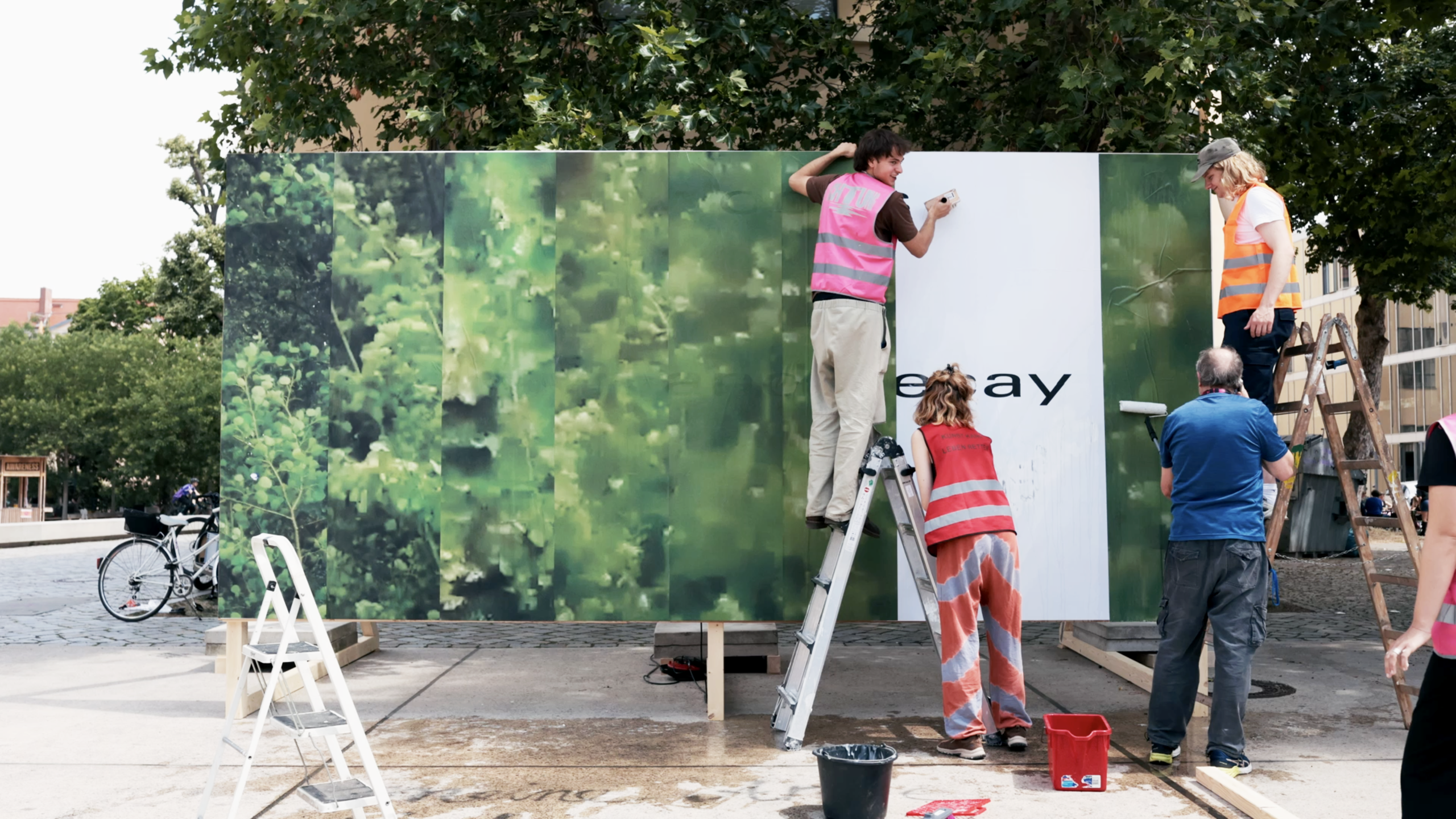
The »PostCompost – Forest Reset« project explores the consequences of monocultures and drought in European forests. Weakened trees provide ideal conditions for bark beetles. A freestanding billboard, on which new posters are regularly affixed one on top of the other, documents the ongoing research process and highlights the changes taking place.
The exhibition forms part of the festival’s theme, »Future Begins – Negotiating Humanity«. »Relational Interactions« explores the responsibilities people bear within complex ecological and technological contexts, and how we might rethink our relationship with living beings, materials and technologies.
Ars Electronica Festival 2026 »Future Begins – Negotiating Humanity«
Exhibition dates: Wednesday 9 to Sunday 13 September 2026
Location:
University of Art and Design Linz
Hauptplatz 8, West Building
4020 Linz
Participating artists: Sabah Abouelhadid, Atso Airola, Mujahid Ali, Tim Auzinger, Fritzi Mathilda Buhtz, Christian Doeller, Prof. Kerstin Ergenzinger, Klaus Fritze, Anna-Maria Galani, Dania González Sanabria, Johann Joesten, Diana Karle, Nina Kegel, Zakhar Komarov-Zelinskii, Katharina Langenhan, Krittaporn Mahaweerarat, Jan Munske, Udo Noll, Tan Oktik, Radu Paul Simon Reinhardt, Adam Schmidt, Leandra Schieder, Ayca Tugran
Curators: Prof. Ursula Damm, Prof. Kerstin Ergenzinger, Mindaugas Gapševičius
Exhibition architecture: Jan Munske, Viviane Morais Dantas
Design: Said Berkin Yesil
Funding: The STIL Foundation supported the production of the artworks as part of the ‘Strategies for Non-Machines’ project.
Further information:
Relational Interactions:https://ars.electronica.art/negotiatinghumanity/en/view/relational-interactions-37b38ddb450c8195b659c02ab684394c/
Ars Electronica: https://ars.electronica.art/negotiatinghumanity/de/